When Packaging Becomes Part of the Food
Parents pay close attention to what goes into their children’s food. They read ingredient labels, compare nutrition facts, and look to brands they trust.
But a new report is raising a different kind of question.
What if the packaging itself contributes something that doesn't appear on the label?
A newly released report commissioned by Greenpeace International has brought renewed attention to baby food sold in flexible plastic squeeze pouches. Researchers analyzed two popular baby food products and detected both microplastic particles and plastic-associated chemicals in the food tested.
The findings do not prove that packaging was the only source of microplastics in the products. The researchers acknowledged that some particles and chemicals could have come from other points in the manufacturing or processing chain.
But the report does add to a growing body of concern around plastic food-contact materials and the role packaging may play in microplastic exposure.
What the Study Found
The research examined two baby food products packaged in flexible plastic pouches.
Independent laboratory testing by SINTEF Ocean in Norway, detected microplastics in both products. According to the report, researchers found up to 54 microplastic particles per gram of food in one product and up to 99 particles per gram in the second product. The study estimated that individual pouches contained more than 5,000 and 11,000 microplastic particles, respectively.
The laboratory also identified plastic-associated chemicals in both the packaging materials and the food itself.
The study does not establish a direct source for every particle or chemical detected. That distinction matters. Food products can encounter plastics and other materials at multiple points before they reach the consumer.
Still, researchers noted that polyethylene was among the most frequently identified materials in the samples analyzed. Because polyethylene is commonly used as an interior layer in flexible pouch packaging, the findings raise important questions about whether some particles may be linked to the packaging system itself.
That question deserves more research. It also deserves serious attention.
Why This Matters for Infants
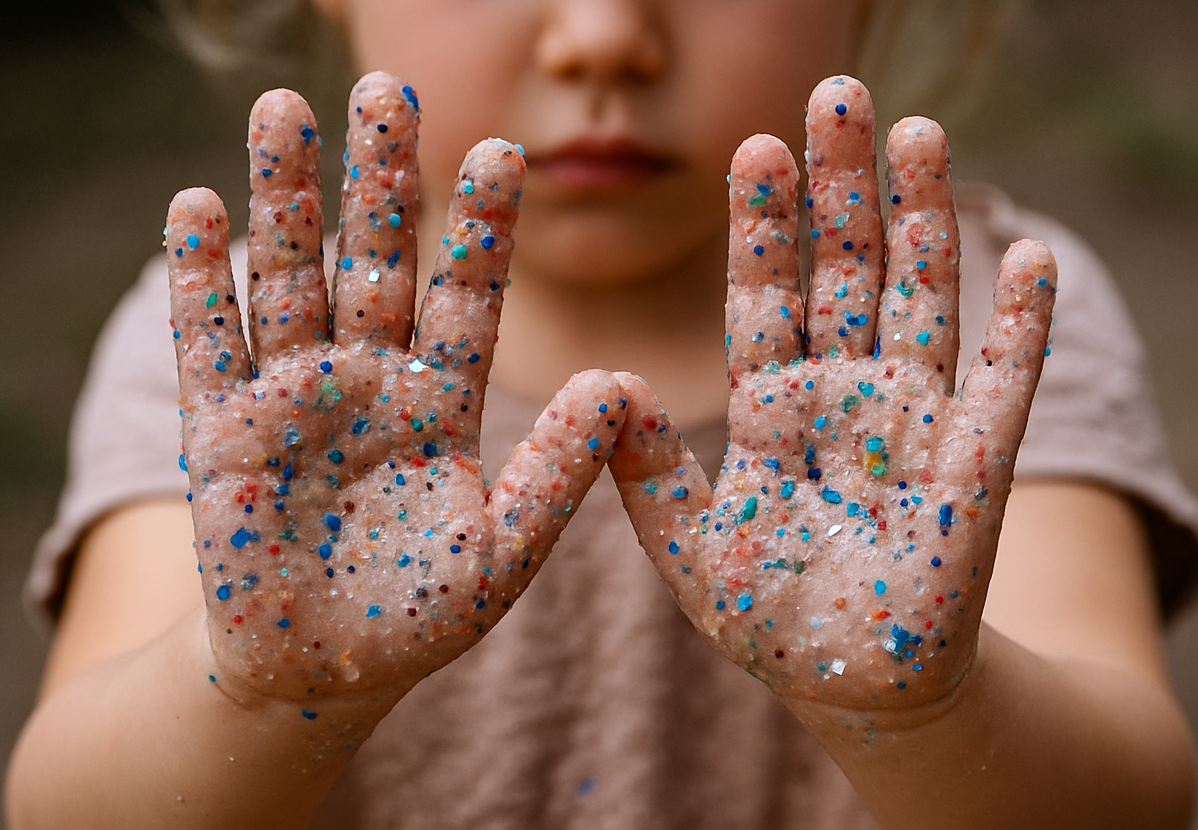
Infants and young children are not simply smaller adults. They eat and drink more relative to their body weight, and their bodies are still developing.
Scientists are still working to understand the long-term health implications of microplastic exposure. But concern has grown as microplastics have been detected in human blood, lungs, placentas, and other tissues.
That does not mean every exposure creates a known health outcome. It does mean that reducing unnecessary exposure is a reasonable goal, especially when children are involved.
Food packaging is supposed to protect what we consume. It should not become part of what we consume.
The Bigger Packaging Conversation
Flexible plastic pouches have become common in the baby food market because they are lightweight, portable, and convenient. For busy families, that convenience is easy to understand.
But convenience often comes with a material tradeoff.
Many flexible pouches are made from multiple layers of plastic and foil. That structure helps protect the product inside, but it also makes the packaging difficult or impossible to recycle through conventional systems. Once discarded, these materials can persist in the environment, fragment over time, and contribute to the broader microplastics challenge.
That is why this conversation cannot stop at one study, one product category, or one brand.
The larger issue is material design.
Can we deliver the safety, convenience, and performance people expect without relying so heavily on persistent plastic materials that can remain in the environment for decades or centuries?
At RWDC, we believe that question belongs at the center of the packaging conversation.
The Fourth R: Replacement
For decades, plastic waste solutions have been framed around three familiar principles: Reduce, Reuse, and Recycle.
Those principles remain important. We should reduce unnecessary consumption. We should reuse products where reuse makes sense. We should recycle materials that can be effectively recovered and returned to productive use.
But microplastics expose a challenge the original Three Rs were not designed to fully address.
Reduce, Reuse, and Recycle largely focus on what happens after a product has already been made. Microplastics force us to ask an earlier question.
Should a persistent plastic have been used for this application in the first place?
That is where the Fourth R comes in: Replacement.
Replacement does not mean every plastic should disappear from every application. Some uses require durability, longevity, and specific performance characteristics that conventional plastics can provide.
But many single-use and short-lived products are different. They are designed to be used briefly, discarded quickly, and recovered inconsistently. In those applications, material choice matters.
Replacement asks whether persistent plastics can be substituted with materials designed to perform during use and return more safely to natural systems at the end of their useful life.
That is not waste management. It is pollution prevention by design.
Where RWDC Fits
RWDC is focused on that material challenge.
Through Solon® PHA polymers, RWDC is developing materials designed to provide the functionality consumers and brands expect while offering a fundamentally different environmental profile from conventional plastics.
Solon PHA is produced from renewable resources and designed to biodegrade across a wide range of natural environments. Unlike conventional plastics that can persist and fragment into microplastics over time, PHA materials are designed to return to natural systems through biological processes.
That difference matters.
As concerns around microplastics continue to grow, brands, policymakers, and consumers are asking better questions about the materials used in everyday products. Packaging is no longer just about shelf life, convenience, and cost. It is also about what happens when that package leaves our hands.
The future of sustainable packaging will require better design, better recovery systems, and better material choices.
No single solution will solve the microplastics challenge. But for applications where persistent plastics create lasting environmental and human-health concerns, Replacement must be part of the conversation.
Reduce what is unnecessary. Reuse what can be used again. Recycle what can be recovered.
But where persistent plastics are likely to escape collection systems, enter natural environments, or contribute to microplastic formation, the better answer may not be managing them more effectively.
It may be replacing them altogether.
That is the Fourth R.
This article references Greenpeace International’s report on microplastics and plastic-associated chemicals detected in baby food sold in flexible plastic pouches. The study’s findings point to the need for additional research into exposure pathways, health impacts, and the role packaging may play in introducing microplastics into food products.